Confessions of an Aging Barbie Girl

I drew the small brush over my nail and raised my hand closer to the light to inspect my handiwork. “Barbie pink,” I said with satisfaction. It was a gesture of homage. I was a Barbie girl at sixty-four.

When I was young, I aspired to be like Barbie while making peace with our differences. Her curly blond bangs and long ponytail pulled tight and shiny against her head couldn’t have been any more different than my straight, dark brown bob cut. Her curvy, ill-proportioned body looked nothing like my undeveloped, shapeless form. She was a California beach bum. I lived in Medford; the best I could do was an occasional ride to Revere Beach on the weekend. But despite our differences, I imagined an unrealistic future when I would drive a pink convertible and date a boy as cute as Ken.

The hype around this summer’s Barbie movie restored my connection to a favorite toy of my youth. I hadn’t thought about my Barbies for years, not since I spent my childhood summers rotating between my friends’ backyards where we “played Barbies” seated at splintery, wood, a-frame picnic tables. We toted plastic-handled pastel carrying cases plastered with Barbie’s image and filled with extensive wardrobes to each other’s homes, playrooms, and patios. Each day, we invented a different reason for Barbie, Skipper, and Ken to switch from bathing suits to formal attire–a prom, a wedding, or a tea party with Midge, Barbie’s best friend. We dressed and undressed our dolls ad nauseam, choosing from our extensive day and evening wear collections. We forced tight skirts over out-of-proportion hips, pulled stretchy tops over perky bosoms, and slid matching shoes over permanently tip-toed feet, only to undo our handiwork moments later for the next imaginary social event.

I never realized until now that Barbie provided a formative experience in my childhood. She introduced me to a love of style absorbed through exposure and osmosis. Barbie was like a gateway drug to adulthood, a glimpse at ultimate femininity. Playtime became an unintended tutorial in good grooming and fashion; Barbie taught me everything I know about accessorizing and color coordination. She became a pop culture icon; I became a lifelong Barbie girl.

Long after the days of Barbie picnic table proms and weddings, I applied Barbie style standards to my career wardrobe. I plucked blouses, skirts, and dresses from the racks at Filene’s, asking myself, “What would Barbie wear?” I trawled through shoe displays at Jordan Marsh in search of Barbie-worthy footwear. Barbie’s wardrobe of pumps and sandals inspired my favorites. I wore lofty heels and straw wedges with aplomb from young adulthood into middle age. I crammed my toes into pointy styles, repressing the pain caused by precariously high heels. Nowadays, as an aging Barbie girl, I spend my shopping trips gazing longingly at four-inch heels while I futilely search for marginally stylish but sensible shoes. I can’t lie–the loss of sassy footwear stings. Barbie is ageless. I’m not as lucky.

The aging Barbie girl in me reflects with melancholy on the superficiality of cute clothes and an unattainable figure. The escapism of Barbie’s beach-centric life and pink convertible feels like comfort food for a hungry, ancient heart. I pine for a simpler time without aches and pains when cute shoes and the possibility of a future with a pink convertible fueled my future dreams. In contrast to my Barbie days, growing old isn’t child’s play, but I gladly indulge in the guilty pleasure of entering her world and the chance to slip into my Barbie girl identity once more.


Seriously Winning Christmas

If giving is truly better than receiving, then ‘winning Christmas’ is the ultimate giving coup. Our family adopted the idea of winning Christmas as a way to acknowledge the really great gifts–the ones that make the receiver happy, really happy. On Christmas morning, I watch with a discerning eye to detect winning. Once in a while, a gift is received with such enthusiasm, it’s difficult to ignore–a clear-cut Christmas win. Other times, it’s tough to tell how a gift truly lands. In the moment, most gifts are received enthusiastically but I worry that an hour after the unwrapping carnage ends, the receiver forgets about, or worse, never uses the item. It’s a gamble that, for me, induces a serious case of agita.

I take gift-giving very seriously. I think back to last Christmas as I flip through the Mary Englebreit “The Magic of Christmas” themed notebook I have used for years to track my purchases. On the pages I’ve designated for each family member, I assemble lists of ideas, past gifts, and stocking stuffers. It’s a system of checkmarks and multiple color ink, scratch outs, and additions that keeps me from giving embarrassing repeat gifts and reminds me of past Christmases won. My notes remind me of the good and the not-so-good gifts, and what to focus on in the next round of buying and gifting.

This past Christmas, the winning stakes were a bit higher than usual. My son and his partner, Rachel, came ‘home’ to Boston for the holiday. Scott moved to Texas over five years ago and although we see each other a few times a year, it’s difficult to pick up on the new, evolving tastes and interests he acquires eighteen hundred miles away. I understood and feared the challenge ahead of me.

On Christmas morning, I positioned myself next to the tree to dole out the piles I had assembled for each family member. A smallish box containing Bose sunglasses teetered at the top of the boxes earmarked for Scott. The sunglasses were a risky purchase, much like any gift I purchase for him. I watched as he tore off the silver and gold wrapping paper and opened the box. He can be a tough one to please but these sunglasses, with speakers built into the temples near the ear, clearly hit the spot.

“Oh, I know what these are,” he said, having worked on a project that promoted the technology when it was new five or so years ago. I sensed his enthusiasm; he was clearly smitten with his new gift. A few hours later, I walked into the living room to see Scott sitting in the wing chair, staring off through his new Bose sunglasses. As he listened to something I figured was a podcast, I popped my head into his line of vision and he nodded in silent acknowledgment of my presence. Again, my heart was full, that is, once I got over the weirdness of the kid wearing sunglasses in the house.

When I chose the Kate Spade crossbody bag for Rachel, I knew I was taking a chance, not really sure of her taste or if she would like something like that. After we finished the gift exchange, I walked past the kitchen where I spied her dumping out the contents of her well-loved, well-worn, brown crossbody purse onto the kitchen table. As she transferred her wallet and the rest into her new bag, I couldn’t help but ask how she liked it.

“It’s good. I only wear crossbody bags,” she told me.

I marked that moment in my Christmas notebook as another Christmas win.

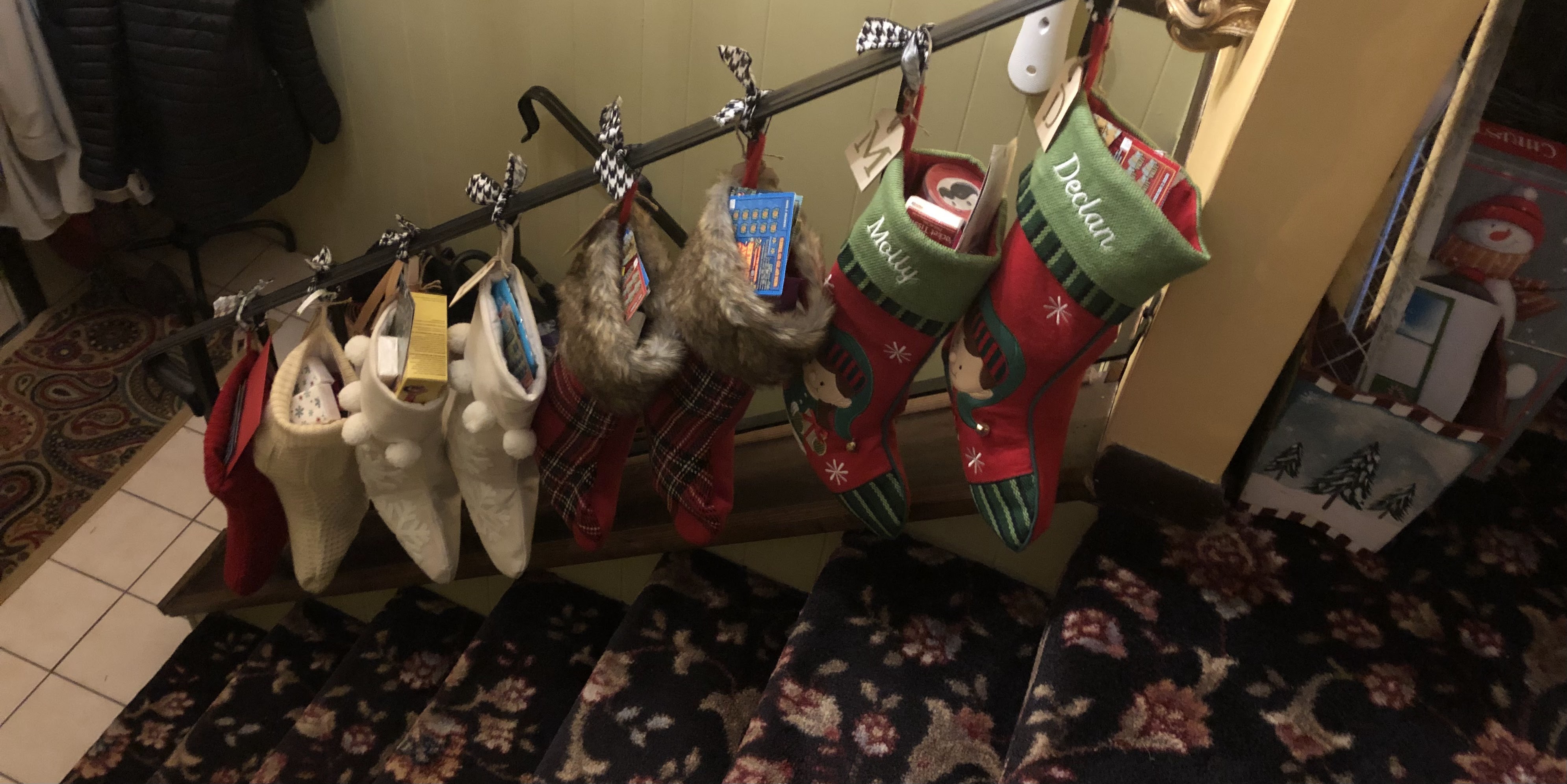
This year, the winning continued long after we unearthed our livingroom from red and green, tinsel-tinged glitter bomb of wrapping paper, discarded boxes, half-scratched lottery tickets, empty stockings, and toys of both grown-up and kiddie varieties. Three weeks into the new year and long after I rested on my Christmas gift giving laurels, my daughter, Lisa, sent me a text. I was sure it was to remind me to pick up our grandson at school that afternoon. Instead, she gushed about a silver and aquamarine bracelet I had given her for Christmas. She had worn it to a work gathering the evening before and had received compliments on the piece. 

“It’s not too delicate?” I asked. 

“Oh, not at all! It’s so pretty. I love it!” 

I appreciated her taking time out of her day to tell me how much she liked my gift. She understands I take winning Christmas very seriously and I live for feedback, especially the unsolicited kind. And is there anything better than knowing the joy of Christmas lives far beyond the season?

I happily report that the winning didn’t end there. A few days ago, my Apple watch buzzed with a text from Scott. Now safely back in Austin, he and Rachel had cashed in another Christmas gift from his dad and me, a gift certificate for a Cozymeal cooking class. His text featured a series of pictures of food and people. Instead of the suggested “Italian meal,” they had chosen a southern-inspired feast. I recognized the grits straightaway.  

I typed back, “How was it?” 

“It was fun,” he said. “Wanna hear the weirdest thing? Everyone in the class was from the Boston area.”

Besides being thrilled that they enjoyed the experience, his report made me wonder–maybe a few other moms and dads from Boston, with kids who live in Austin, had won Christmas, too. 

I can’t remember a time when Christmas winning lasted into February but I’m not complaining. As you can see, I take winning Christmas very seriously; for me, it truly is better to give than to receive.

Dinner And Some Whine

Hanover Street, Boston’s North End

On Saturday evening, my husband Tim and I ventured out to our favorite haunt, Boston’s North End. A hundred years ago, my family called the Italian enclave ‘home,’ but I visit my roots not to trace the steps of those who came before me. Instead, I go to eat, drink, and people-watch. On a warmer than usual spring night, the streets bustled with plenty of people and plenty to watch. 

For our dining venue, we chose Quattro, a smallish restaurant at the end of the first block of Hanover Street, the main drag that dissects the neighborhood. I had read the reviews: Good Bolognese. Attentive waitstaff. A little cramped. I would earn 1000 Open Table points if I grabbed the 5:30 p.m. reservation. Once I set aside my fears of a “blue-hair, early bird special” designation, I booked it and hoped for the best. 

The hostess seated us at a table nestled in a long row of small tables for two, smack dab in the middle of the dining room. I recalled the online review, and I agreed with the description: cramped. The place was busy for such an early hour. Tim assessed the tight conditions, but with his seat facing a screen over the bar tuned to the Bruins playoff game, he settled into the coziness and the game. I barely noticed his lack of engagement in conversation. I had plenty to keep me busy as I gazed out the large windows that opened to the street. I had a front-row seat to the parade of young girls in sundresses and guys in fitted Hawaiian print shirts, and a steady stream of Mike’s Pastry boxes. It was a quintessential North End spring evening.

I turned my attention within, to the restaurant and the sociological experiment far more interesting than the tourists outside. Our waiter, a friendly young man with a thick accent, appeared and took our drink orders. Within moments, the seats on either side of us emptied. My eyes followed a group of four as the hostess led them to a table tucked in the corner, out of the fray. Amazingly, the men navigated the tight aisle even with their eyes focused on the screen and the game. As the hostess motioned to the table, one of the men in the party surveyed the situation–table, screen, table, screen. 

“Is there a better table?” he asked. 

The hostess remained focused on her task of seating the group, never taking account of the inventory of seats, and said, “No, this is the only table of four available.” She was firm and clearly prepared for pushback. 

The guy looked around, as if to question her judgment. He hesitated a few more seconds and looked over his shoulder once again. “Are you sure?” 

“Yes. Sorry.” The hostess placed the menus at each seat at the table, spun on her heel, and walked away, ending the conversation.

I kicked Tim under the table. “Did you see that? What the hell?” He glanced over at the landlocked party four, and after a fleeting moment of empathy, resumed his own viewing with selfish relief.

A few moments later, a middle-aged couple was shown to a table for two next to us. The gentleman paused, looked around, looked at us, and asked “Is there another table? How about over by the window?”

Initially, I felt judged and snubbed, but then I realized the guy was an ass. The hostess humored him, glancing across the crowded room. “Those are reserved, sorry.” 

The man shrugged and took his seat. Although like Tim, he had a great seat to view the game, he clearly wasn’t a fan. With his eyes riveted on the empty seats by the window, he complained to his wife, “Those tables are just sitting there empty. Do you think they are really reserved?” 

The woman muttered something inaudible as she looked down at her menu. He followed her lead, commenting on the entree choices until his attention was drawn to the couple the hostess seated at one of the coveted tables.

“See! See! She gave them the table! I told you!” His wife’s eyes remained on her menu. 

Smirking, I looked at Tim and said semi-loudly, “I’m definitely writing about this.” The man overheard me and probably wondered what I meant. My cryptic comment silenced his whining. I sipped my Cosmopolitan with satisfaction. If my lousy sociology degree from Boston College makes me a quasi-expert on human behavior in groups, my evening out provided a first-class lab experience. As a writer, I’m always looking for material for an essay to pitch or a new Mami blog post. As the stars of observation, investigation, and communication aligned, I knew I had a Mami on the horizon.

Although our dining experience at Quattro was brief (we finished eating within an hour), the restaurant itself didn’t disappoint; unfortunately, the clientele and their behavior did, but I accepted my fate in the cause of social science. I continued my research at our next stop, Caffe Paradiso. Things became interesting as we enjoyed gelato on “the patio” (patio: parking spaces in front of the building set off from the traffic by jersey barriers). Three no-so-young men sat next to us, yipping, howling, and high-fiving while videoing themselves and their antics. I assumed they figured, being outside, the rules of dining decorum didn’t apply. I feigned immunity to their foolishness until I hit my breaking point. I shot them a dirty look but nothing about their behavior changed. To cushion the aggravation, I ordered another Nutty Irishman coffee, grateful for the Brookline Ice truck that had pulled up beside the men. I welcomed the unpleasant drone of the reefer unit as it competed with the rest of the noise.

As I resume a social life after two years, the post-pandemic novelty has yet to wane but my patience with the post-pandemic behavior of others has. The sociologist in me detects an uncomfortable change in human nature. Is it a byproduct of isolation, or being denied freedom? Or are people naturally jerks? As I now watch bad behavior and rudeness in public settings, I struggle to remember the way things were, but I am convinced people have become less aware of the negative impact of their attitudes and actions on others. Shunning manners is one thing; having no sense of personal douchiness is another.

If you recognize yourself in any of the anecdotes above, check yourself next time you feel the need to be a jerk in public. To the men intent on securing the best real estate to enhance their short stay at a restaurant, get over yourselves. No one cares, especially the hostess who fields requests like yours all day. To the loud, obnoxious patio sitters, simmer down. To my waitress, hand me my wine…and my pen. I need to write this stuff down. I feel a Mami coming on.

How Far Haven’t We Come?

When I was a teenager in the 1970s, on just about every first day of school, the WBZ morning news on our kitchen television blared with the background theme to my bowl of Cheerios. Scenes of buses filled with kids of color being escorted through white neighborhoods, the sounds of violent protests, and images of police officers lining the streets to ensure safe passage to school buildings for little Black kids didn’t make much sense to me then. As a child, I also rode a school bus but none of those things happened in my neighborhood, just five miles from the Boston city limits. I thought briefly about how scary it must be to go to school, surrounded by upheaval. Then I happily went off to school without giving it much additional thought.

I grew up in West Medford, in a unique corner of a medium-sized city on the outskirts of Boston. Our area was special, with a small Black community woven into the fabric of our neighborhood. Life in West Medford included interracial interaction occurring naturally between the residents of ‘the Ville’ and us, the white people. We were neighbors. Living in this environment made it even more difficult to understand those scenes of the first days of school on the news. In a way, it made it even more difficult to understand racism.

When my father attended Medford High School in the 1930s, he formed colorblind friendships that endured for a lifetime. A man named Oscar Greene, a local author and memoirist, remained one of my father’s closest friends and, as a child, I often visited Oscar’s home with Dad, to drop off a tool or to just say ‘hi.’  My fondest memories of my days in an interracial Girl Scout troop at the Shiloh Baptist Church included learning to sew from Norma Jeffers, my beloved troop leader. I know that my experiences were unique. I also know that they made me a little ignorant of what it was like to be a Black person in America. 

When I visited the Lyndon Baines Johnson Presidential Library in Austin last year, the experience brought back memories of my own life-the images that I saw as a child, my semi-charmed life in an interracial neighborhood, and my insulation from the continuing struggle that minorities face in America. Johnson was an interesting character. He spoke like a racist, calling Blacks by degrading names and putting on a good show for segregationists, who believed that he was one of them. When Johnson signed the Civil Rights Act of 1964 into law, he acknowledged the need to elevate the cause of equality and social justice. To some extent, Johnson recognized his own racism and understood that we all needed to do better, himself included. 

How far have we come? I fear not very much. As I watch the protests that once again bring to light the need to reiterate the message that we are all equal, I think about my history lesson at the LBJ Library and the realization that our America qualifies civil rights, justice, and equality using a color litmus test. We do not yet live as equals and perhaps the Civil Rights Act of 1964 may not be worth the paper that LBJ signed in 1964 unless we recognize that, like Johnson himself, we still have work to do. 

The passing of John Lewis brings our role as activists into sharper perspective. So many years ago, Lewis championed peaceful protest to affect change and, to some extent, change happened. But we remained ignorant of the on-going plight of Black Americans.  We lulled ourselves into believing that we had made steady, sustained progress toward equality. Or worse, we didn’t care about the economic disparity and injustice that Black Americans endure. The latter thought disgraces us as a country, and as human beings. 

With the polarization of our country regarding the topic of race relations, unfair policing, and civil rights, we prove that have only begun, or worse, have reversed direction on the road toward a genuine belief that we are truly equal. Our commitment must go beyond planting a sign in our yards or a painting message on a street. Black men and women should not hesitate to walk our streets, fearing that they will be questioned or detained without reason. Our daily lives must embody inclusive and respectful actions. We must respond with outrage when the rights of the marginalized are violated. Only when we demonstrate truly deep-seated, universal protection of the rights of Black people as equally entitled to safer communities, the protection of voting rights, and fair treatment in the workplace will we change the way our society functions once and for all.

The Perfect (Snow)Storm

Image result for snow pictures woods

I purposely stayed away from supermarkets these past few days since I knew that it would be madness.  The weather people had been warning those of us in the greater Boston area that there was snow forecasted for Saturday so plan accordingly. Granted, the accumulation was predicted to be in the 1-3 inch range or worst case scenario, outside of 128 (the highway that for some reason is the line of demarcation in these situations), accumulations may top out at six inches; yet, I knew from experience that the stores would be chaos. As I took a quick assessment of my supplies of milk, bread, and booze, I decided that I most likely could survive until Sunday when the onslaught of the three inch deluge would be over. 

It would be a quick one, meteorologists said, over by midnight. And since the first flakes only started around three p.m, even at multiple inches an hour, which was unlikely, I could see that it was not going to be a big deal storm. In any case, the viewers were warned to stay home. It was treacherous! Dangerous conditions! Armageddon! Over time I have learned that the news people tend to exaggerate the onslaught in the cause of ratings and viewership so I resisted panic. In any case, I was happy to oblige. For me, it was a ‘perfect storm’.

I love snow, especially when I have no plans. For me, there is nothing more pleasant than a weekend storm, of the three to four inch variety, that deposits a perfect, glistening, white coating on the ground, shrubs, and trees – that I can look at from inside of the house. A glass of wine, a binge of a TV show on Netflix or Hulu, and fuzzy pajamas and I am fully equipped for the duration of the precipitation. I should mention that, while I love snow, I hate to go outside in it. I am a secret admirer, a closet snow junkie, who avoids interaction with the cold, wet stuff while adoring the beauty from a distance. 

As for winter activities, I have learned to ski, although I do not ski. I have ice skates, although I seldom skate. And I have a snow shovel, which I dodge using as much as possible. In the cause of skiing and skating, I adopted these skills not to be defeated by them. Both require being out in the cold. Both are not enjoyable and offer no appeal to me. Since shoveling requires no real skill, I have tried to identify as a dedicated shoveler, but I have failed. I thought about buying a pink shovel that I had seen at Reny’s in Damariscotta a few weeks ago but I knew that the purchase would not cure my aversion. When it comes to shoveling, like skiing and skating, I avoid it at all costs. Yet, the guilt that washes over me when I steal a glimpse of the entire family outside shoveling and cursing is enough to make me suck up my distaste for the activity and join in the ‘fun’. Dragging my heels while suiting up for the misery, I do my best to look like a team player. In the end, I am usually ready to make my grand contribution to the snow shoveling effort as close to completion as possible. It is a worthy attempt. That should count. And sometimes, I even make cocoa and a banana bread as a reward for everyone’s hard work, my contribution to the snow removal effort and a means to ease my conscience.

This Sunday morning, we woke up to the remains of a ‘perfect storm’ – a minor accumulation of the light and fluffy variety, easy to shovel, and falling on a weekend when there is no pressure to get up and out.  I reveled in the effects since the beauty of a freshly fallen, light blanket of snow fills me with such joy. Mid-morning, I heard voices outside and looked to see my husband and son-in-law as they chatted casually while pushing the light snow around. They seemed happy. I was happy, too. The pressure was off. It would not be necessary to join the chain gang of snow removal, avoiding a guilt trip. I poured another cup of coffee and settled in with a book, assuming a seat on the wing chair in the living room from which I had a clear view of the woods. Breathtakingly beautiful, the trees glistened as they donned their sparkling white coat. I imagine it’s cold out there, and a little wet. I wouldn’t know. And here was no need to find out.