On Saturday evening, my husband Tim and I ventured out to our favorite haunt, Boston’s North End. A hundred years ago, my family called the Italian enclave ‘home,’ but I visit my roots not to trace the steps of those who came before me. Instead, I go to eat, drink, and people-watch. On a warmer than usual spring night, the streets bustled with plenty of people and plenty to watch.
For our dining venue, we chose Quattro, a smallish restaurant at the end of the first block of Hanover Street, the main drag that dissects the neighborhood. I had read the reviews: Good Bolognese. Attentive waitstaff. A little cramped. I would earn 1000 Open Table points if I grabbed the 5:30 p.m. reservation. Once I set aside my fears of a “blue-hair, early bird special” designation, I booked it and hoped for the best.
The hostess seated us at a table nestled in a long row of small tables for two, smack dab in the middle of the dining room. I recalled the online review, and I agreed with the description: cramped. The place was busy for such an early hour. Tim assessed the tight conditions, but with his seat facing a screen over the bar tuned to the Bruins playoff game, he settled into the coziness and the game. I barely noticed his lack of engagement in conversation. I had plenty to keep me busy as I gazed out the large windows that opened to the street. I had a front-row seat to the parade of young girls in sundresses and guys in fitted Hawaiian print shirts, and a steady stream of Mike’s Pastry boxes. It was a quintessential North End spring evening.
I turned my attention within, to the restaurant and the sociological experiment far more interesting than the tourists outside. Our waiter, a friendly young man with a thick accent, appeared and took our drink orders. Within moments, the seats on either side of us emptied. My eyes followed a group of four as the hostess led them to a table tucked in the corner, out of the fray. Amazingly, the men navigated the tight aisle even with their eyes focused on the screen and the game. As the hostess motioned to the table, one of the men in the party surveyed the situation–table, screen, table, screen.
“Is there a better table?” he asked.
The hostess remained focused on her task of seating the group, never taking account of the inventory of seats, and said, “No, this is the only table of four available.” She was firm and clearly prepared for pushback.
The guy looked around, as if to question her judgment. He hesitated a few more seconds and looked over his shoulder once again. “Are you sure?”
“Yes. Sorry.” The hostess placed the menus at each seat at the table, spun on her heel, and walked away, ending the conversation.
I kicked Tim under the table. “Did you see that? What the hell?” He glanced over at the landlocked party four, and after a fleeting moment of empathy, resumed his own viewing with selfish relief.
A few moments later, a middle-aged couple was shown to a table for two next to us. The gentleman paused, looked around, looked at us, and asked “Is there another table? How about over by the window?”
Initially, I felt judged and snubbed, but then I realized the guy was an ass. The hostess humored him, glancing across the crowded room. “Those are reserved, sorry.”
The man shrugged and took his seat. Although like Tim, he had a great seat to view the game, he clearly wasn’t a fan. With his eyes riveted on the empty seats by the window, he complained to his wife, “Those tables are just sitting there empty. Do you think they are really reserved?”
The woman muttered something inaudible as she looked down at her menu. He followed her lead, commenting on the entree choices until his attention was drawn to the couple the hostess seated at one of the coveted tables.
“See! See! She gave them the table! I told you!” His wife’s eyes remained on her menu.
Smirking, I looked at Tim and said semi-loudly, “I’m definitely writing about this.” The man overheard me and probably wondered what I meant. My cryptic comment silenced his whining. I sipped my Cosmopolitan with satisfaction. If my lousy sociology degree from Boston College makes me a quasi-expert on human behavior in groups, my evening out provided a first-class lab experience. As a writer, I’m always looking for material for an essay to pitch or a new Mami blog post. As the stars of observation, investigation, and communication aligned, I knew I had a Mami on the horizon.
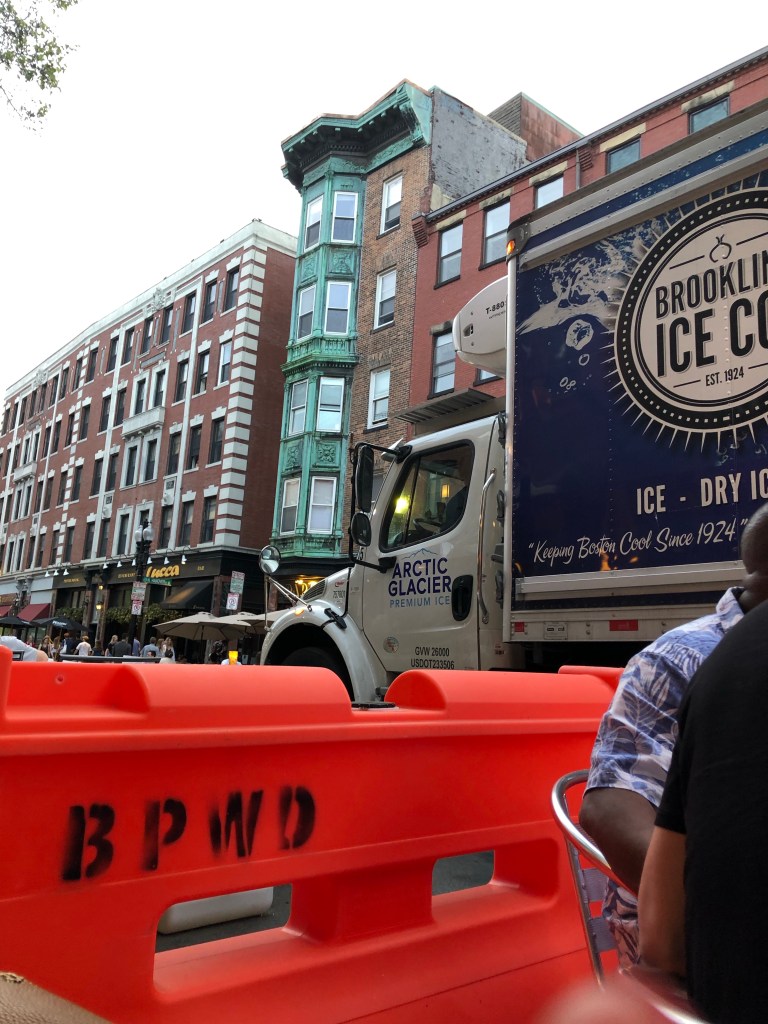
Although our dining experience at Quattro was brief (we finished eating within an hour), the restaurant itself didn’t disappoint; unfortunately, the clientele and their behavior did, but I accepted my fate in the cause of social science. I continued my research at our next stop, Caffe Paradiso. Things became interesting as we enjoyed gelato on “the patio” (patio: parking spaces in front of the building set off from the traffic by jersey barriers). Three no-so-young men sat next to us, yipping, howling, and high-fiving while videoing themselves and their antics. I assumed they figured, being outside, the rules of dining decorum didn’t apply. I feigned immunity to their foolishness until I hit my breaking point. I shot them a dirty look but nothing about their behavior changed. To cushion the aggravation, I ordered another Nutty Irishman coffee, grateful for the Brookline Ice truck that had pulled up beside the men. I welcomed the unpleasant drone of the reefer unit as it competed with the rest of the noise.
As I resume a social life after two years, the post-pandemic novelty has yet to wane but my patience with the post-pandemic behavior of others has. The sociologist in me detects an uncomfortable change in human nature. Is it a byproduct of isolation, or being denied freedom? Or are people naturally jerks? As I now watch bad behavior and rudeness in public settings, I struggle to remember the way things were, but I am convinced people have become less aware of the negative impact of their attitudes and actions on others. Shunning manners is one thing; having no sense of personal douchiness is another.
If you recognize yourself in any of the anecdotes above, check yourself next time you feel the need to be a jerk in public. To the men intent on securing the best real estate to enhance their short stay at a restaurant, get over yourselves. No one cares, especially the hostess who fields requests like yours all day. To the loud, obnoxious patio sitters, simmer down. To my waitress, hand me my wine…and my pen. I need to write this stuff down. I feel a Mami coming on.


 Mami Knows Everything