Present Tension and Imperfect Past: Rewriting My Story In A New Tense (Part One-My Italian Family)

A trulli, prehistoric houses found in Cisternino–the homeland

I am an orphan, although at my age it’s difficult to claim such a title since most of my friends are orphans, too. Most of our parents are gone. In my case, I am an only child but one might assume I have some extended family but before departing this life, my parents, or more specifically, my father, saw to it that almost all of our relatives disowned us. Money, houses, and territorial foolishness caused multiple rifts. Years later, I realize my family is the sum of the people I chose or created myself. Luckily, I chose well and created some pretty awesome humans, so I am better off than many.

Still, we somehow managed not to alienate one branch of my family tree. My only child mother maintained a relationship with her paternal side, a collection of thick-accented Italian aunt and uncles who one-by-one came to America by sea over the course of thirty years, from the early 1920s until the mid-1950s. When I was a child, this spirited bunch enhanced my childhood as they fiercely held on to their traditions, spoke in another language, and demonstrated a palpable zest for life.  

The presence of my Italian relatives spiced up our family gatherings. One aunt, Annuziata, spoke only Italian. Because of her, I learned to understand Italian. Even so, I never learned to speak the language (except for the bastardized expressions my mother and grandmother used–all grammatically incorrect and sometimes offensive). A simplistic conversation with Aunt “Nancy” (her Americanized name) sounded like this–

Nancy: “Vieni qua!” 

Me: “No, I’m not coming over there.” 

Nancy returned to the old country for good in the late1960s and with her went my cursory knowledge of the Italian language and my sassy ability to be a Euro-brat.

Aside from my Aunt Nancy and my Uncle Dario, both of whom lived for a time in my grandparents’ three-decker in East Boston, the rest of my Italian relatives settled in upstate New York. Grandpa’s brother and sister, Nick and Grace lived in Utica and Rochester, respectively, along with their spouses, Mary and Pete. Grace and Pete had one daughter (we seem to specialize in only children). Carmela was a few years older but I remember our childhood times together. Pete, Grace, and Carmela returned to Italy in the early 1980s, leaving me with memories and a few 8mm movies taken by Dario that memorialized the golden era of my Italian immigrant family in America.

Sadly, my Italian family never totally assimilated into American culture as proven by their collective gnawing desire to go “home.” With each of their departures, a part of me was laid dormant. For years, my mother and Aunt Grace communicated by phone, but back then, international long-distance phone calls cost a small fortune and required coordination. These well-planned trans-Atlantic conversations transpired in the late evening, Boston time, and early morning, Italian time. When my mother died in 2003, my father made one last call to our relatives to announce her passing, effectively closing the door on my Italian family forever.

Over the years, I have thought about reconnecting with whoever was left in Cisternino, my grandfather’s hometown, the place to which my family returned. I scoured phone records, Facebook, and ancestry sites for clues. Once I thought I had unearthed Carmela’s address in an Italian version of the online White Pages and wrote a letter that was never answered or returned. I wondered if she had ever received it or maybe she was cutting me off as well. It had been a long time. Did she even remember me?

My curiosity persisted. The history of my family intrigues me and I admit to a mild obsession with Grandpa Conte and his story. This summer, as I randomly searched for clues to my grandfather’s family and any link to my heritage, I searched Facebook once more. I typed in Carmela’s name–and there she was, picture and all. She looked the same, older but the same. As I typed a note in Messenger, I knew I was taking a chance. Maybe it was the wrong person after all. Maybe she didn’t want to connect. Or maybe this was my chance to salvage a remnant of my past and my family. I pressed ‘send’ and waited.

A few weeks later, as I scrolled through my iPhone screens, I clicked on the Messenger icon. Carmela’s message put to rest any fears. 

Hello Marie…I’m so very very happy to hear from you. I often thought of you. 

She continued, sharing the news of a newborn grandchild the month before, which explained the delayed response. When she proposed a video chat, her mixture of Italian and English endeared her to me even more. 

We have a six hour differenza…I will wait for your risposta…LOTS OF HUGS AND KISSES

We arranged a call for that afternoon. After a few first joyous moments face-to-face, we reminisced about the members of our family who had now passed. While writing my memoir these past few years, so many questions had arisen. With no one to help me fact-check, I depended on the spotty memories of a little girl and the questionable facts ascribed to stories I had been told. Now, through technology, I found family and a resource to answer my questions. Carmela is my last living relative with a link to those sketchy images and the truth.

Over the course of ninety minutes, we shared and clarified details that supported my own recollections. I asked questions about things I had always wondered about. With her responses, my cousin added to, rearranged, and upended what I had believed to be the truth. The call ended. I sat back and took a deep breath. We had discussed a range of family lore but one revelation decimated a story I had never questioned. Part of my truth was a fantasy. My head swirled with more questions than before. I had some research to do. 
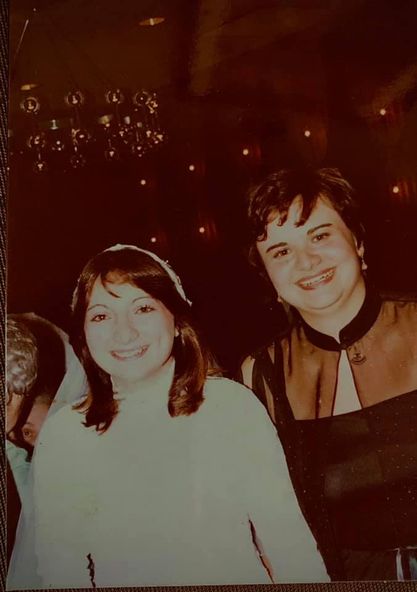
Carmela and me 1980

(Next: Part 2–Not Seeing and Still Believing)

Coming to America:  My Grandfather’s Gift

Image result for immigrant 1920s

Once upon a time, there was a young man, timid and frightened, who boarded a ship bound for America. With a promise of a place to live, as confirmed by a Western Union telegram, and a few dollars in his pocket, he embarked on a journey that forever would change him, his life path, and his family back in the Old Country. At that time in Italy, Mussolini was in control and his regime actively drafted young men for service in the Fascist army.  Knowing that he could not stay since his fear of war was greater than his fear of the unknown, he took a chance.  And so begins the story of Frank Conte, my grandfather, my hero, and an immigrant American.

While I could tell virtually the same story for three out of the four of my grandparents, Frank’s story is the most profound. A genteel man of exquisite taste and a love of culture, Frank’s appreciation for America and the life he found here fueled his determination to survive. Born in 1902 in Cisternino, Brindisi, near Bari in Italy, Frank was one of eleven children. He was the oldest, and the first, and one of the few to leave. In turn, his emigration cast a pall on the family, with my grandfather deemed a defector since he was a conscientious objector. It wasn’t that he was a coward; he just couldn’t embrace Facism and its constraints, or the rule of Mussolini, or the thought of being a soldier. In leaving, he knew that he may never see his home again, or his mother, whom he loved dearly.  Yet, he persisted.

Once he arrived in the United States, Frank applied himself to the business of “being American.” He was a keen observer of the American way of life and assimilation was a vocation for him.  He met and married my grandmother, a woman of means and Italian descent, already established since her family had come to America in the late 19th century. My great-grandfather was a tailor and a shrewd business man, working his trade and buying up numerous properties on Chelsea Street and other places in East Boston.  My grandmother was “gifted” a house on Eutaw Street by her father upon their marriage, a gift that my grandfather was determined to repay. To do so, he worked at all sorts of low level jobs.  When he became a father in 1928, he seized the opportunity as a way to be as American as possible.  Studying an American baby name book, he searched for as un-ethnic a name as he could find for his baby. For a boy, he decided on the name “Arnold”; but if the baby was a girl, she would be called “Ethel”, after Ethel Barrymore, the silent film actress. Neither name quite particularly desirable, “Ethel” became Mary and Frank’s only child. Later on, my mother, by her own admission, was grateful for her gender, despite the still-awkward moniker.  In essence, she saw the name “Ethel” as the lesser of two evils.

After the Great Depression, the year after Ethel was born, things became dire and my grandfather gratefully took any jobs he could find. He swept streets for the WPA and accepted the free food offered by the government, even though it bothered him greatly.  In time, he found work in a casket factory, where he learned the skill of furniture finishing. Terrified of the idea of death, caskets freaked him out, but never more so than the day that someone closed the lid of the casket in which he was working.  My grandfather was always an anxious person and this event was truly formative.  He never returned to that job after that day. Fortunately, the war effort was burgeoning and Frank soon found work in the Charlestown Navy Yard, as many patriotic Bostonians did. It was noble work, and it paid well.  And Frank never felt more American.

I always thought that my grandfather’s anxiety sprung from being psychic. He just knew too much.  For example, when his mother died in Italy, he knew long before the arrival of the telegram. My grandmother found him one day, standing by their third floor bedroom window in the middle of the night gazing out on the quiet street. Concerned, she approached him and asked what he was doing. He replied, “I am watching my mother’s funeral going by.” Within days, confirmation of his mother’s passing arrived in the form of a telegram.  While I think that his other worldly ability was a blessing, he was terrified of what he knew, without even knowing.

Deeply religious, my grandfather had a sense of the mystical. His Catholic faith, combined with his underlying psychic abilities, made for an interesting combination. Every May and June, he created altars in his home, out of reverence to the Blessed Mother and the Sacred Heart, respectively.  He created an oasis in the city in his back yard with the installation of statuary recreating the events and participants of the visitation in Fatima, all colorfully painted and strategically illuminated. It was actually quite beautiful, with abundant roses, snowball bushes, bleeding heart vines, and a trellis covered in ivy, under which a cushioned swing was housed. A fountain with a young boy, created by him, where the water spewed from an unmentionable place, made for a humorous addition to all the sanctity.

Returning the favor bestowed upon him, Frank assisted my great uncle, Dario, in attaining a sliver of the slice of the American Dream that he had attained.  Dario, who was highly educated with a ‘Doctorate in Engineering’ from the University of Pisa, came to live in the spare room between the second and third floors of the tenement, created by closing off an extra room in the second floor apartment.  He found work in Boston at Stone and Webster, a prestigious engineering firm. Born after Frank came to the United States, Dario became the son that my grandfather never had.  Frank was happy for the connection to his home that Dario provided and, even though his life in America was all he could have hoped for, he never stopped longing for his family and his beloved Cisternino.  I guess that’s just the life of the immigrant.

After the war, Frank found a job at Rapid’s Furniture, a preeminent establishment in Boston’s West End. The company’s furniture factory, located in Charlestown near City Square, was a cement fortress with high windows and little ventilation.  It was there that Frank became sick and was forced to retire.  Years later, this building was the scene of a horrific conflagration where fire fighters died due to the poor construction.  Ultimately, it killed my grandfather as well.

It was during his years at Rapid’s that I was born. I was the pinnacle of joy for my grandfather and he couldn’t get enough of me. A collection of photographs remain as testimony to his doting on me, fussing and cuddling his precious and only grandchild.  I can still remember him squeezing me as if to meld our lives and energies permanently. When I find myself over-kissing or hugging my own grandchildren, I sense a channeling of Grandpa. At least, he always comes to mind, making the connection between us strong despite his passing almost fifty years ago.

Frank eventually went back to Italy in the late 1950’s and again in 1966. In the latter trip, he took my grandmother “home”. It would be the last time. A few years later, Frank became desperately ill with liver damage as a byproduct of his years inhaling denatured alcohol as a furniture finisher in an unventilated shop.

On the day he died, I remember feeling ill in Sister Gemella’s seventh grade Math class and I asked to leave the room. It was 8:45am on the morning of November 18th, just two days after my twelfth birthday. As I stood there, by the twin white porcelain sinks of the third floor girls’ lavatory, I sensed something, but I had no idea what. Relieved that the nausea passed a few minutes later, I returned to class and my day’s activities. Later that day, both of my parents picked me up from Girl Scouts, which I knew was a bad omen.  Grandpa had died that morning at 8:45am, leaving me with a never-ending psychic and emotional connection to a man of courage, determination, and faith.

As I think back on Grandpa’s story, this quiet, gentle man was a survivor.  Never above whatever it took to get by, he was the epitome of the American Dream and a casualty of it, as well.  I wonder sometimes if I don’t get some of my scrappiness from him, although on the surface, you would have never detected this trait in the man that I knew. But when I think of him and all of my immigrant predecessors, I know that I would have never had the strength or courage to seek a new life, even in the midst of poverty or repression. I think of Grandpa especially as I consider the immigrant heart. He was fearful and fearless, all at the same time. But in the end, his gift, and the gift of all of my grandparents, is this life of comfort, privilege, and perhaps excess that I enjoy.  Would I ever sweep a street? Am I above taking government food? I am fortunate that I don’t have to. But I recognize the burning desire of those who want to better themselves and their human condition, and the sacrifices that they are willing to make to attain their goal.  And who am I, with traces of the immigrant heart in my DNA, to judge or refuse them that privilege?

Image result for immigrant heart